Unknown consumers
A credential may look isolated in the vault while applications, scheduled jobs, CI pipelines, and third-party integrations quietly depend on it.
SecretOps
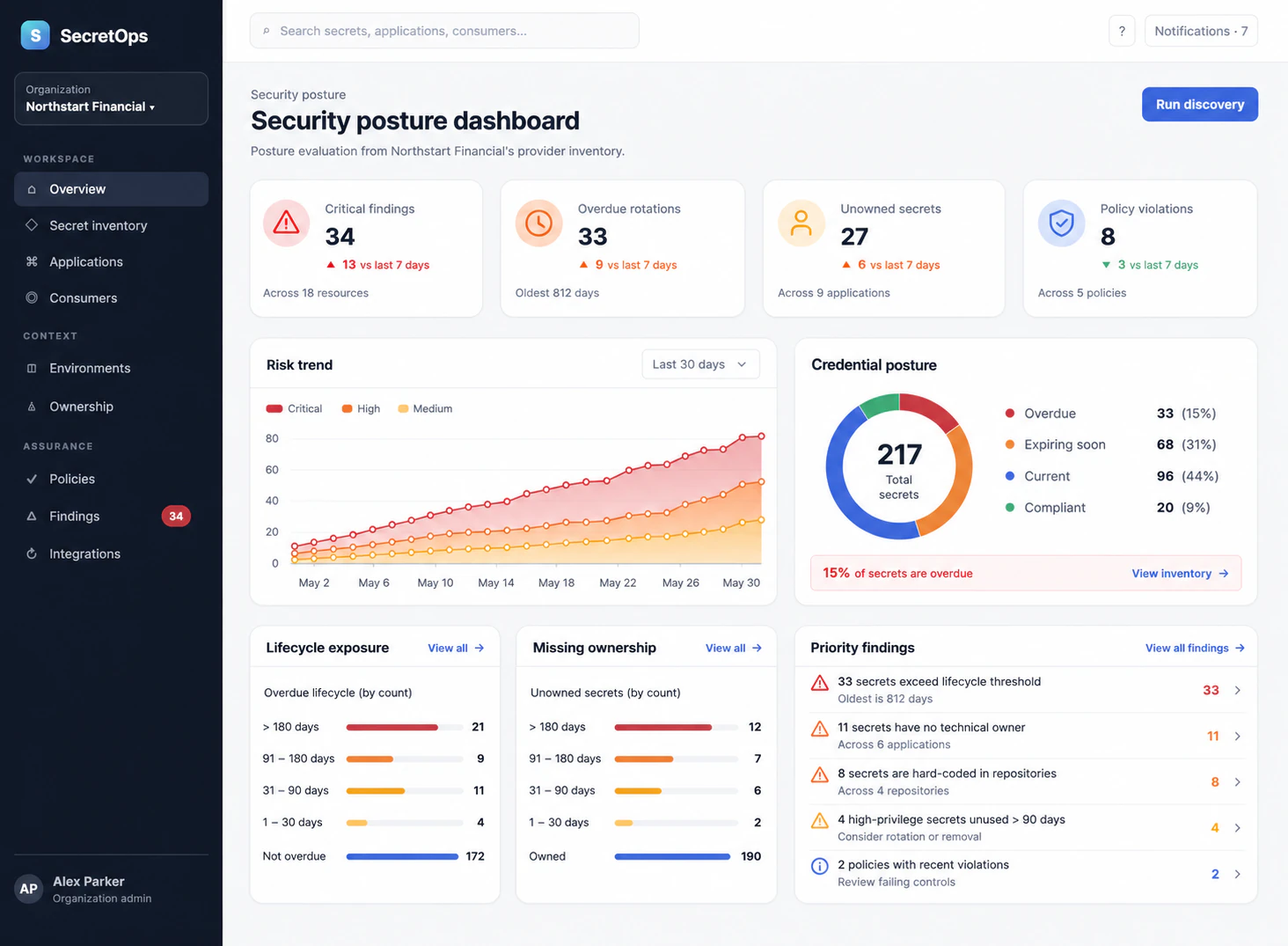
SecretOps gives enterprise teams a source of truth for ISO-aligned secret ownership, dependencies, lifecycle evidence, and rotation readiness without becoming another vault.
Problem
Enterprise teams often centralize secrets in vaults, cloud secret managers, or Kubernetes. That solves secure storage, but it does not automatically answer the operational questions teams face months later: who owns this secret, what uses it, can it be rotated safely, and what will break if it changes?
Unknown consumers
A credential may look isolated in the vault while applications, scheduled jobs, CI pipelines, and third-party integrations quietly depend on it.
Missing owners
The team that created a secret may have reorganized or moved on, leaving security without an accountable decision-maker.
Rotation fear
Without impact, rollback, and validation context, a routine credential change becomes a production-risk event.
Orphaned secrets
Old credentials remain active because nobody can prove whether they are unused, safe to revoke, or still tied to a forgotten workload.
Policy Catalog
SecretOps includes a ready-to-use catalog of credential security policies designed to help organizations establish governance without starting from a blank page.
Included policy domains
Adaptable policy as code
Organizations can adopt the catalog as a baseline, strengthen policies for their own requirements, or define custom policies through Terraform or API.
Evidence mappings connect applicable policies to relevant ISO/IEC 27001 and PCI DSS control objectives for audit preparation.


Designed for demanding audits: SecretOps policies align credential governance with relevant PCI DSS requirements and ISO/IEC 27001 control objectives, giving teams clearer, more relevant evidence when auditors evaluate ownership, access, lifecycle, and cryptographic-key custody.
Integrations
SecretOps operates as a read-only metadata and registry layer. It does not require storing actual secret values.

HashiCorp Vault

GCP Secret Manager

AWS Secrets Manager

Azure Key Vault

Kubernetes Secrets

Doppler

Akeyless

CI/CD systems

Git repositories

CMDB / ITSM tools
What It Does
SecretOps tracks the metadata, relationships, lifecycle, and accountability around secrets while leaving the actual secret values inside the existing vault or secret manager.
Secret registry
Maintain operational records for secrets across teams, systems, and environments.
Ownership and backup ownership
Track who is accountable when a review, incident, migration, or rotation arrives.
Consumer and dependency mapping
Connect each secret record to the applications, jobs, workflows, and systems that depend on it.
Rotation readiness
See whether owner, consumer, rollback, validation, and impact details are complete before change.
Review and expiry tracking
Keep lifecycle dates visible so stale records do not drift silently.
Audit evidence exports
Collect review notes and operational evidence for security and compliance conversations.
A deliberate security boundary: SecretOps does not store credentials, passwords, tokens, private keys, or secret values. It governs the operational record around them while the sensitive value remains in the vault or secret manager already responsible for protection and delivery.
Control Evidence
A useful control is more than a policy statement. SecretOps preserves who reviewed a secret, what they decided, which exception was accepted, what changed, and whether the dependent systems were validated afterward.
Secret asset register
Every discovered secret becomes a governed metadata asset with backend location, environment, application, purpose, owner, and lifecycle state.
Lifecycle review evidence
Review decisions, timestamps, reviewers, exceptions, rotation notes, and validation evidence are retained for audit conversations.
Risk indicators
Missing owner, unknown consumers, stale review, overdue rotation, deleted backend secret, and production impact are surfaced as operational risk.
Control mapping
SecretOps records connect secret lifecycle activity to security control themes such as asset inventory, access governance, cryptographic key management, logging, monitoring, and change control.
Complements Vaults
It does not replace encrypted secret storage, delivery, or access controls. It adds the operational context teams need before changing, rotating, deprecating, or deleting a secret.
Vault / Secret Manager
SecretOps
Separation of Duties
In enterprise environments, the team that stores a secret is often not the team that owns the application, consumes the credential, approves the change, or validates production after rotation. SecretOps gives every role a clear record so rotation does not depend on tribal knowledge or risky guesswork.
Secret custodian
Team responsible for the vault or secret manager location.
Secret owner
Team responsible for why the secret exists.
Consumer owner
Team or application depending on the secret.
Rotation operator
Person or team performing the rotation.
Validator
Person or team confirming the dependent systems still work.
Approver
Person or team approving rotation or lifecycle changes.
Use Cases
SecretOps supports the actual decisions teams make across a secret’s lifecycle-from establishing ownership and mapping dependencies to approving exceptions, planning rotations, proving review, and retiring obsolete credentials.
Pre-rotation impact assessment
Identify owners, consumers, validation steps, rollback requirements, and business impact before changing a production credential.
Secret ownership review
Give every active secret a primary owner, backup owner, reviewing team, and a clear escalation path.
Production secret inventory
Build an operational register organized by environment, application, backend, purpose, risk, and lifecycle state.
Orphaned secret cleanup
Separate truly abandoned credentials from poorly documented ones before revocation or deletion.
Audit evidence package
Export ownership, reviews, exceptions, lifecycle decisions, and rotation evidence without reconstructing the story by hand.
Cloud migration readiness
Map credential dependencies before applications and workloads move between vaults, clouds, accounts, or clusters.
Rotation Readiness
Before a production secret is rotated, SecretOps can show whether the required operational knowledge exists: owner, consumers, rollback notes, validation steps, last review, and business impact.
Infrastructure as Code
SecretOps is adopted through the same workflow teams already use to create cloud secrets. The Terraform provider registers or updates the SecretOps metadata record whenever a secret is created in GCP Secret Manager, AWS Secrets Manager, Azure Key Vault, HashiCorp Vault, or another supported backend.
Built for delivery policy
resource "oft_secretops_secret_record" "example" {
  name            = "payment-gateway-api-key"
  vault_provider  = "gcp_secret_manager"
  vault_reference = "projects/payments-prod/secrets/payment-gateway-api-key"

  environment     = "production"
  application     = "Payments Platform"
  purpose         = "Authenticates outbound payment gateway requests"

  owner           = "payments-platform-team"
  backup_owner    = "security-operations"

  rotation_policy = "90_days"
  business_impact = "high"

  consumers = [
    "payments-api",
    "settlement-worker",
    "refunds-service"
  ]
}
Next Step
If rotating a secret feels risky because nobody knows what depends on it, SecretOps closes that gap.